Showing posts with label Biking With Nature. Show all posts

Sunday, January 22, 2012

The Iceman/woman Cometh

photo by Caitlin Johnson
When you think of -20F with a windchill of -40F do you say, "Hey, today seems like a GREAT day for a bike race"?  If so, maybe you should consider entering the Arrowhead 135.

As I write this, in my 65F house in Madison, Wisconsin, it's -17 in International Falls, MN--the start location for the 8th annual race.  Come January 28th/29th, 135 brave (some may use different terminology) souls will make their way to the sign-in/gear check meetings.  That Sunday night, they will fall asleep with bellies full of spaghetti, hoping for good trail conditions and minimal equipment failure.

When the Arrowhead 135 started in 2005, only 10 racers made it to the start line.  Now, it has somewhat of a "cult" following and is used by Alaskans training for the Iditabike.  Racers fall into three categories:  bike, ski with pulk sled or foot with pulk sled.  All will start at 7am, Monday January 30th.  All must finish the 135 miles of snowmobile trail, ending in Tower, MN by 7pm Wednesday.  Most choose to bike because of the speed, however, with fresh snow, many of the cyclists will push their bike for miles.


foot racers
photo by Dave Pramann

Anything and everything can happen during this race and although the top finishers won't spend a night out "camping", every racer must carry mandatory gear at all times--or become disqualified.  Racers must be prepared to sleep out if poor conditions hit and since this race is 100% unassisted, this usually means carrying 30-40lbs. of gear.  Although there are three checkpoints, racers cannot receive assistance from non-racers unless there is a medical condition.  From start to finish, all racers MUST carry a -20 degree sleeping bag, an insulated sleeping pad, a tent or bivy sack, firestarters, a stove, 8 ounces of fuel (they must finish with 8 ounces left over), a pot, a 2qt. insulated water bottle, a headlamp, red LED blinking lights (so as not to become a hood ornament on a snowmachine), a whistle, and 3,000 calories at all times (must finish with this leftover).  Remember, this is just the "mandatory" list--the recommended list doubles it.

Lance Andre, Jeff Oatley, Jason Buffington

The male record holder is still Dave Pramann, current race organizer with his wife Mary Pramann.  In 2006, he finished on bike in just 15 hours, 45 minutes!  The women's record was shattered last year by Alaskan, Heather Best.  She finished on bike in 20 hours 14 minutes and placed 8th overall.

As you might guess, people are a  part of this solely for the love of it.  It's 100% non-profit--all entry fees go to operational costs.  If there is any money left over, it goes to helping provide college scholarships to children of US Special Ops soldiers that were killed or injured.  Volunteers make this race possible!  Although the organizers rotate, Dave and Mary Pramann have put the race on for the past two years.  Without folks like these, Arrowhead 135 would not exist.

So, you've read this and still want to try your hands at winter racing?  Fantastic!  First things first.  Read Dave Schlobowske's blog piece on winter bikes at www.bfw.org.  Next, go out and test ride as many winter bikes as you can (there are often times demo days).  Read "Of Wolves and Men" by Barry Lopez--if you're riding in Northern MN or WI in the winter, you'll encounter a few.  Try your hand at a shorter winter race--there are several in the Midwest.  Okay, you're set.  Slap on a smile underneath that balaclava and layer of Vaseline and have fun!

Dan Dittmer
photo by Allison Long
Dave Pramann and Charlie Farrow
photo by Mike Curiak

Tuesday, January 17, 2012

Zinn and the Art of Bicycling


Lennard Zinn at cyclo-cross nationals 2012
photo by Nathan Vergin


Imagine a world where you step into a bike shop with someone and the person you're with is treated like a rock star.  Crowds form around him, pictures are taken, hands go out to be shaken, pats on the back and a beer magically appears.  You might even see some female cyclists swoon--actually, the guys might be swooning as well.

This was my perspective when Lennard Zinn was in town for cyclo-cross nationals and we walked into Machinery Row bike shop for their Belgium party.  It was kind of amusing...but then again, I got it.  Growing up I cared a lot more about pro racers than rock stars--they were my rock stars.

So how did I find myself in this position?  Thanks to a good friend, Jon Patz, who was an old roommate of Lennard's, I got to have dinner with him and interview him after his race.  I was even treated to a story of them knitting hats in their college dorm room.

It's hard not to spot Lennard in a crowd.  He's 6'6-6'7, has a lean athletic build and warm smile.  For those of you not familiar with his work, the list is long.  First, he's written several books on bike maintenance including the mechanic's bible "Zinn and the Art of Bicycle Maintenance".  He's the technical writer for VeloNews.  He started Zinn Cycles where he designs and builds custom mountain, road, cross and tri bikes.  He designs components and clothes to fit tall and short riders and he also races (both bike and cross country ski).

How did he get involved with all of this when he started out as a physics major?  Simply put, he loves bikes and bicycling!  During dinner we were talking about the start of Zinn Cycles and he said, "Contrary to what most people think, I actually got into this because I was tired of seeing shorter women bounce around in their saddles due to cranks that were too long for them."  I have to admit that even I thought his driving force was to help taller riders.  As a hard to fit rider myself, it's wonderful to see a frame/component builder care so much about sizing.

Scott Anderson, a 6'6 yoga instructor, here in Madison, is a believer in what Zinn is doing.  I asked him to contribute to this piece and here's what he sent:

 It was nearly twenty years ago that I first rode a Zinn bike. In the days before Internet ubiquity, information was more likely to be passed word-of-mouth, and I'd heard that Lennard Zinn was the go-to guy for big bikes. Well, I certainly needed one of those big bikes at 6'6"! I had been riding an off-the-shelf Ritchey, which was a gorgeous piece of equipment, though it didn't even come close to fitting. Via the combined efforts of an extra-long seat post and a supple spine, I thought this bike was as good as it gets. The Ritchey ultimately showed its age, however, and it came time to replace my trusty steed.

On a trip to Boulder, Colorado in 1993, I swung by Lennard's shop. Rather than talking about bikes and fitting, Lennard suggested we go out for a ride. He let me ride his bike, and he grabbed another as we rode about the Boulder reservoir. Within about ten minutes I'd decided to purchase this bike; it tracked straight (lacking the twitchiness I associated with a high-end bike) and did not require committee-approval to turn. It was the smoothest, easiest-riding, fastest and most comfortable bike I'd every ridden!
I loved that bike, and poured on off-road miles all over the Southwestern US, and gobs of commuting miles in both Minneapolis, MN and Madison, WI. (Even after it was completely and utterly tired and worn, it still commanded a respectable bid on eBay last year.) People properly appreciate Lennard's gift for building the right bikes for BIG people.
Since Scott is a yoga instructor, he also mentions that although he can help people become more adaptable and resilient, those things can only go so far.  He sees so many riders trying to make too-small bikes work for them but one size does not fit all.

Lennard is so dedicated to helping those that are hard to fit that he started a program with basketball players and the Boulder Center for Sports Medicine.  Zinn and Andy Pruitt, a certified athletic trainer, work with athletes on bike fitting to help them prevent back, knee and neck injuries.

Zinn has not only been a leader in bike fitting but also in using different frame materials.  Although he loves steel, his bikes now lean towards titanium and magnesium.  Until cross nationals, I had never seen a magnesium frame.  After his race, while his bike was still covered in mud, I picked it up.  Even with a full water bottle and a few pounds of mud, it was still lighter than my much smaller carbon frame.  My jaw dropped and I think I drooled a bit.  Calculations of how I could scrape enough money together to get one of his frames started dancing in my head.  The best part is that his frames are made right here in the United States!

Lennard and Dag after the race
photo by Jon Patz

I couldn't resist sending Lennard a few questions for this post.  Here they are with his responses plus photos:

 1)       What is one of your fondest cycling memories?

Winning the Durango-to-Silverton Iron Classic road race in 1980. Felt like I was floating that day. I set the course record that held until Jonathan Boyer smashed it a couple of years later.
One very hilly stage of the Tour of Ireland in 1981 where I felt great, initiated the break, and won the Most Aggressive Rider award.
  2)      Regarding bicycle building, what frame are you most attached to and why?

Wow. Hard question. I guess I'd never throw out or sell the first bike I ever built (in 1980, for my girlfriend who became my wife). 
I'm currently most attached to both of my cyclocross bikes (http://www.cyclingdirt.org/coverage/247673-USA-Cyclocross-National-Championships-2012/video/559767-Leonard-Zinn-Very-Technical-Cyclocross-National-Championships) , but I'm sure they'll be replaced within a few years, so that hardly seems like attachment. 
I poured my heart and soul into the Columbus KL steel lugged bike of my wife's. She still rides it, we'd never get rid of it, and it weighs like 15 pounds, built back in 1984 or so.
My wife and I haven't ridden our tandem in years, but we are very attached to it, as it is what we rode when she was pregnant with each of our daughters. It has kisses all over it under the clear coat.
  3)      When you first started building, were there any frame builders that influenced you and why?

I worked for Tom Ritchey after having only built one bike prior to that. I even lived at his house part of the time; the shop was in his garage up on Skyline Drive above Palo Alto. He had a very strong influence on me. Between Tom, me and one other guy, we built around 100 fillet-brazed Ritchey mountain bike frames, forks, and Ritchey Bullmoose fillet-brazed handlebars a month (at the very beginning of the mountain bike boom in 1981). Understanding how a small operation could be super productive was very useful to learn, and for the bikes I made in the 1980s until the mid 1990s, it was great that I had learned from Tom how to fillet braze (and without air bubbles) and especially how to finish the fillet so that it was super smooth and made a beautiful transition from tube to tube.
I learned how to weld titanium and tricks of building frames out of it from Gary Helfrich, the founder of Merlin. 
Otherwise, I was inspired by the beauty of old-world lugged frame craftsmen when I was starting out.

 4)      What bikes are you riding now?

I have two matching 17-pound magnesium cyclocross bikes with single chainrings and 205mm cranks visible here
http://www.cyclingdirt.org/coverage/247673-USA-Cyclocross-National-Championships-2012/video/559767-Leonard-Zinn-Very-Technical-Cyclocross-National-Championships and in the below photo of me and DAg Selander by Jon Patz (he and I have lots more from nationals).
http://zinncycles.com/Zinn/index.php/cyclocross/1532-2
In five minutes, thanks to replaceable dropouts on both sides, I can convert them to singlespeed 'cross bikes (see photos of red bike below).

I have a sub-17-pound Zinn Fassa magnesium road bike with Campy Super Record 11-speed. I love that bike for long mountain rides.  http://zinncycles.com/Zinn/index.php/test-page/project-big-custom-series/fassa-mg

I have a titanium bike with four couplers on the frame and a coupler on the titanium stem that I travel constantly all over the world with. I've raced a lot of Gran Fondos in Italy and Canada on it. I can pack it in about 10 minutes into a 28 X 28 X 10 case that flies free. This video shows me packing it and shows Madison's native Olympic Gold Medalist on her Zinn coupled titanium bike.http://zinncycles.com/video/Travel-Bike-Promo.html?keepThis=true&TB_iframe=true&height=355&width=455. This bikes gives me incredible freedom and allows me to have great rides wherever I am.
I also have a steel bike with four couplers on the frame that has such a beautiful green powder coat on it that I rarely travel with it, but I do ride it a lot around here. (My titanium travel bike is unpainted and hence I don't worry about scratching it when traveling.)
I ride the 6-inch travel Zinn Gigabike 29er equipped with SRAM X.0 and Fox TALAS Terralogic fork that is on the cover of Zinn and the Art of Mountain Bike Maintenance. https://bigandtallbike.3dcartstores.com/Zinn-and-the-Art-of-Mountain-Bike-Maintenance-5th-edition_p_136.html 

I ride a titanium 3-inch travel Zinn Tyrant 29er equipped with SRAM XX components and fork. http://zinncycles.com/Zinn/index.php/about/classic-custom-series/full-suspension/tyrant

I have a bright yellow magnesium track bike that I ride on the indoor velodrome here in Boulder.
All of the above bikes have my custom Zinn cranks on them.

5) You’ve been such an influence on folks wanting to learn bike maintenance.  What would your top three tips for those just starting out--besides buying your books?

1. Just get started working on your bike. Don't be afraid to take something apart. While it's possible you may make a mistake, there's no better way to learn.
2. Build some wheels. It's good for the soul to ride on a pair of wheels you built.
3. Just as you take a shower after riding, spend a bit of time on your bike after every time you ride. At a minimum, wipe the drivetrain with a rag and lubricate the chain after every ride or two.

Me with Lennard Zinn
photo by Jon Patz


Tuesday, January 10, 2012

Don't call us old--call us masters!

Age is an issue of mind over matter.  If you don't mind, it doesn't matter.
                                               -Mark Twain


Lennard Zinn entering the sand pit

I love it.  The dictionary definition of "master" as an adjective is:  Having or showing very great skill or proficiency.  So just by being a cyclist over the age of 35, I am considered a "master".  Of course the other definitions are:  The captain of a merchant ship or a man who has people working for him.  Neither of which I would like to be associated with.

Although most professional racers fall into the "senior" or "elite" categories, it's becoming more common to see women and men kick some serious ass above the age of 35.  The term "masters" is no longer seen as the first nail in the coffin.  In fact, some of the strongest cyclists I know--ones that could ride circles around me--are in their 50's and 60's.  Look at Raul Alcala.  He won the Mexican time trial championship at age 46.

Masters lining up for the start of their race

This past weekend the national cyclo-cross championships fell upon Madison/Verona, Wisconsin.  Droves of people of all ages and abilities came here to show what they've got.  Although the elites in their 20's got most of the fame and glory, I was most interested in watching the masters.  This wasn't just because it's my age category.  They are also beautiful racers to watch.  Long gone are the days of testosterone driven madness where everything is considered a sprint.  No, the masters tend to calculate their moves a bit more.  They know their bodies.  They often realize that holding back sometimes is just as important as hammering all out...and when they go all out, they dance on their peddles.

Dennis Bean-Larson, owner of Hell Yes clothing and Fixed Gear Gallery

For those of you not familiar with cyclo-cross, I'll give you a brief history.  Cyclo-cross began in the early 1900's in Europe.  It was designed to lengthen the training season for cyclists and allow them to ride into early winter.  By forcing the cyclists to ride through pastures and climb over fences it not only kept the riders warm but also improved their bike handling skills.  The first cross championship was held in Belgium in 1910.  From that point on, it spread to Switzerland, Luxembourg, France and Spain.  It didn't really catch on here in the States until the 1970's and only became popular here in the 90's.  The bikes are very similar to road bikes, however, they use knobby tires.  Since the courses tend to be full of mud, water and sand, bikes often times have to be hosed off or switched out during races due to malfunctioning components.  The course consists of a 1.5-2 mile loop where the racers have to make their way over obstacles, up and down steep hills and over different types of surfaces (grass, water, pavement, dirt etc.).  The goal is to get as many laps in as possible in an allotted amount of time.  No other bike race taps into the anaerobic system like cross does.  Think of it as an all out energy expenditure for 30-60 minutes.

Monique Karlen (45-49 category) tearing it up on the course

A few of the racers I was following during nationals agreed to be in this piece.  All are in the masters category and all of them are stronger than most 25 year old cyclists I know.  Dennis Bean-Larson, owner of Hell Yes clothing and Fixed Gear Gallery, talked with me about what pulled him to the sport.  He's only been racing cross for a few years but he has been cycling for decades. One of his main draws is the safety factor. His idea is if you fall on a cross course the chances of getting hurt are a lot slimmer than if you take a spill on the road.  Mud and grass are softer than asphalt!  That's one of the reasons you see so many cross riders over the age of 60--Dennis is 67 by the way.  I just have to add that Dennis rides fixed all winter long--in Michigan--now that's tough!

When I asked Lennard Zinn, frame builder, writer, and racer extraordinaire, what he thought of the course this weekend he said, "It was really cool!  In Boulder we don't get conditions like this.  It's usually dry, hard packed and fast or snowy and icy."  Lennard also talked about what a great family sport cross is.  He often times sees parents racing/training with their kids because the travel distance to races is often quite short.  Lennard was racing in the 50-54 age group and it was great to see his field swell to over 50 racers.

Lennard coming out of a slick turn

Monique Karlen, one of our hometown sweethearts, not only had a great race but also got a ton of media attention.  It's so nice to see women get this kind of attention in a sport.  I sent here a couple of questions to get her perspective on being a female in the masters category:


As a female masters rider, do you feel there is enough being done to get other women out there?

I think as fitness opportunities increase more women are finding cycling in general (and also cyclo-cross.)  In terms of racing there has been a big increase in beginner women (cat 4) in all disciplines over the last several years but races are primarily split by ability level and not age. I do think it would be nice for race promoters to offer a Masters women category as participation increases across the board. I was a competitive runner first and did not discover cycling until I was 35 so started as a master’s racer and have always been racing against women mostly younger than I am.  This said, I know many women over 40 who still are very competitive at the elite level and with women half their age.

As more women of all ages get interested in riding and racing they can join women’s only groups and teams to learn more with a low intimidation factor. Women are generally encouraging and supportive of one another and always happy to get more women into racing and riding. There is still the issue of “equal pay for equal work” and even the top women in pro cycling are not able to make a living or support their racing with payouts and sponsorships not being equal to the men. If race promoters want to attract more top women racers they have to offer equal payouts at minimum.


What changes do you notice in your riding as you get older, both good and bad?

As I get older I notice that my body takes much longer to recover after workouts so I am not able to train as intensely as I used to. As well cycling is a high-risk sport and any injuries take longer to heal. A positive thing about being older as a racer is that I think mentally you are more grounded and have realistic expectations of yourself and can channel the nervous energy differently. Racing can be more fun as you take the pressure off yourself to perform as you once used to and focus on having fun each time you ride! You are thankful for the days on the bike and each day you ride is a good one.  I also see women who begin to race in their 30’s, 40’s and beyond have the enthusiasm of a younger racer because they are not burned out and are really excited about learning something new and feeling good and getting fit.


Monique after her race

I have to say that watching the races this weekend has been an inspiration.  I may have to reconsider my plans for giving road racing a shot again next year and switch to cross!


I want to thank Monique, Dennis, and Lennard for taking time to share their thoughts with me.  Also, a huge thanks to Nathan Vergin for taking pictures at the race and riding down with me!  To see more of his amazing work go to:  www.flickr.com/photos/nathanvergin/


Saturday, December 17, 2011

Bicycling and the Art of Zen

Zen


A handlebar designed by Japanese artist Kosuke Masuda

Being present.  Finding a rhythm between my peddle strokes and breath.  Feeling the slight temperature change between the valleys and hilltops.  Smelling the thawing earth, decomposing leaves, distant cow pastures and the occasional dead skunk.  Seeing the countryside pass by at a rate fast enough to put miles behind me yet slow enough to absorb the details.  Hearing the call of spring peepers, cicadas, and sandhill cranes.  This is why I ride...and often times solo.

I've never been one for seated or still meditation.  For some reason I can't settle into it.  It's like wearing an ill-fitting pair of bike shorts for me.  Instead, I find I can relax into a meditative state while hiking or biking.  Travelling well known routes, ones that I haven't used a map for in years--my bike just seems to guide the way and my mind is allowed to release.

On these days, when everything seems to be "right", poetry sometimes floods my brain.  For a few years now, I've chosen to embrace this and have written quite a bit of Haiku while on two wheels.  Often times I allow it to drift out of my mind before I get home to a notebook and pen.  It's not really about writing it down, it's more about the "dance" I'm having with nature.  As a child I fell in love with Haiku.  The simplicity of it appealed to me as well as the non-rhyming nature.  I am also a lover of nature and Haiku tends to flow with it quite well.  The masters Basho, Busan and Issa all come to mind...writing about the fleeting moments that one cannot grasp.  While on my bike I often times feel this way.  I know that what I'm experiencing will never be repeated in the same sequence.  I could see the same oak tree daily on a ride and it will look different every time depending on the light, wind, time of year.  Instead of mourning this, I am trying to flow with it.  Once in a great while, a Haiku will stick with me.  One that I've never been able to shake is:

Grasshoppers please stay
out of my wheel spokes
you make a big mess

One I recently wrote on my first winter ride of the season is:

Winter wonderland
snow crunching beneath my tires
two tracks left behind

Here's one from Michael Rasmussen:


  Shadow emerges
cool morning soft light sharpens
chase myself Westward


And finally a piece from Basho (translated into English).  It's not on cycling but since I pass cranes almost daily on my rides it makes me smile.

The crane's legs
have gotten shorter
in the spring rain


When I raced and trained for specific events I tended to take myself too seriously.  Always thinking about the future and never truly enjoying what was going on in the present.  Basho wrote, "Make the universe your companion, always bearing in mind the true nature of things--mountains and rivers, trees and grasses, and humanity--and enjoy the falling blossoms and the scattering leaves."  

In 1999-2000 I lived in Kailua-Kona, Hawaii.  I had the pleasure to train and work with many top triathletes.  I remember two sisters that both competed in Ironman competitions around the world.  Both trained seriously and paid their dues.  One of them went on to place well in just about every race she did while the other often struggled.  The difference I think was not in their training but rather in their mindset.  The one that consistently performed well seemed to "play" instead of train.  She received great pleasure in all movement and I rarely saw her without a smile. On the other hand, her sister beat herself up if she didn't do well in a race or during training.  I could tell that she was always making calculations in her head and followed her schedule to the letter...even if she didn't feel like training that day.  I have known many other athletes that seem to follow these patterns and only in the past six or seven years have I allowed myself to soften in my training as well.  The funny thing is that not only do I enjoy exercise more but I think I've actually become a better rider because of it!  It's as if a large sum of weight has been lifted off of me and I now have a new found freedom.
I can't say that I follow this "light" way of thinking all the time.  I succumb to pressures like everyone else.  I consider this all a learning experience and if I can improve just one day by being "here and now" it is all worth it.


Wednesday, December 7, 2011

Biking in a winter wonderland!


THE WINTER CYCLIST

A wintry chill is in the atmosphere,
As from the heaving lake the storm wind blows;
And weak-kneed brethren of the cycle fear
That brings the riding season to close.
Jack Frost assails us with his wicked thrusts;
Our polka-dotted mufflers are on guard
And many a good wheel in the basement rusts
Which should be speeding down the boulevard.

And shall we join the patient, suffering throng,
Which crowds the rumbling street cars to the door?
Which kicks against the service loud and long,
But keeps on riding as it did before?
Nay! Perish such a thought. On every street
The hardy wheelman has the right of way;
No ancient female comes to claims his seat;
No cable breaks, no lumbering teams delay.

Our hearts beat high, our life-blood dancing flows,
Though ice-flakes sparkle in the biting air;
While street-car heaters, every patron knows,
Are but a vain delusion and a snare.
The steed that bore us through the woods aglow
With sunshine, where the morning glories creep,
Will bear us safely through the mud-streaked snow
Until it lies at least five inches deep.

-PETER GRANT, late 1800's

My feet are blocks of ice.  My hands feel like there is sludge in their veins vs. blood.  My limbs are slow to respond to anything I ask of them.  My thoughts are foggy.  I think there is an icicle made of snot hanging from my nose.  Through all of this, there is a smile on my face--although you can't see it under the balaclava and layer of hoar frost.  It is winter in Wisconsin and I'm on my bike!
Am I crazy?  Maybe.  Am I happy?  The remaining unfrozen brain cells scream YES!.  Although this isn't my first choice of weather for riding, there is something to the saying "what doesn't kill you makes you stronger".  

My winter steed is a Surly Cross Check.  A bit rusty form the salt that coats Madison roads.  Definitely grimy--even though it gets cleaned frequently.  My normal winter gear consists of a balaclava, ski goggles when it's below zero to prevent my eyelids from freezing together, several layers of synthetic tops and bottoms, a wind jacket and wind pants, vapor barrier socks, winter cycling boots and Outdoor Research mitts.

Long gone are the days of 50 mile rides.  Now I gear up for commuting into work, running a few errands and partaking in the Madison Bike Winter events.  It usually takes me longer to get ready for the ride than to do the ride itself but most of the time I consider it worthwhile.  I feel like a kid out there after a few inches of fresh snow have fallen (my version of making freshies since I'm not skiing much anymore).  There are times I feel like giving up and those days I choose to walk.  When the sky drops a layer of ice on the road or six inches of slush I just don't feel safe biking anymore (in my old age I've either become soft or smart).  I'm not too worried about falling since I usually take a few spills each winter.  I'm mainly concerned about cars driving out of control or not giving me enough passing room.

Here in Madison there are some really strong feelings about winter cyclists.  In December 2007, Paul Soglin, stated in his blog www.waxingamerica.com "The bicyclists who braved the week's second storm should be taken out and shot."  Mayor Soglin, just "Paul" at the time, was referring to a snowstorm that dumped 5 inches on top of a recent 6 inch snowstorm.  The statement went completely viral in a matter of days.  I was getting e-mails from friends around the country asking me if he really said this and if he was crazy.  The only crazy thing is that he calls himself a bike advocate and claims he has done more for Madison's cycling infrastructure than any other mayor.  Of course after he received hate mail galore, his editor made a snide comment stating "Paul wrote this tongue-in-cheek- you know, a joke.  It's called hyperbole.  Don't get your undies in a bundle.".

O.K., so let's dissect this a bit since I biked to work twice that week.  Were they the safest conditions?  No.  But the roads weren't even safe for cars and the sidewalks/paths were impassible for days.  My work didn't close and if I wanted to get paid, I had to make my way in.  It's funny how Soglin stated that the paths he saw were meticulously clear.  I'm not sure where he was but the paths that I take were actually covered in slush/ice for a month following that storm (even after several calls to the city).  

So here we are, entering another winter bike season.  Soglin is once again mayor and the conceal/carry law recently passed in Wisconsin.  Although I love winter biking, a little bit of me wonders if my base layer should now be a bullet proof vest vs. long underwear.  
Me showing off my base layer at the Winter Bike fashion show
Another winter bike...this one in Madison
One of the bikes from the 2011 Arrowhead Ultra 
135
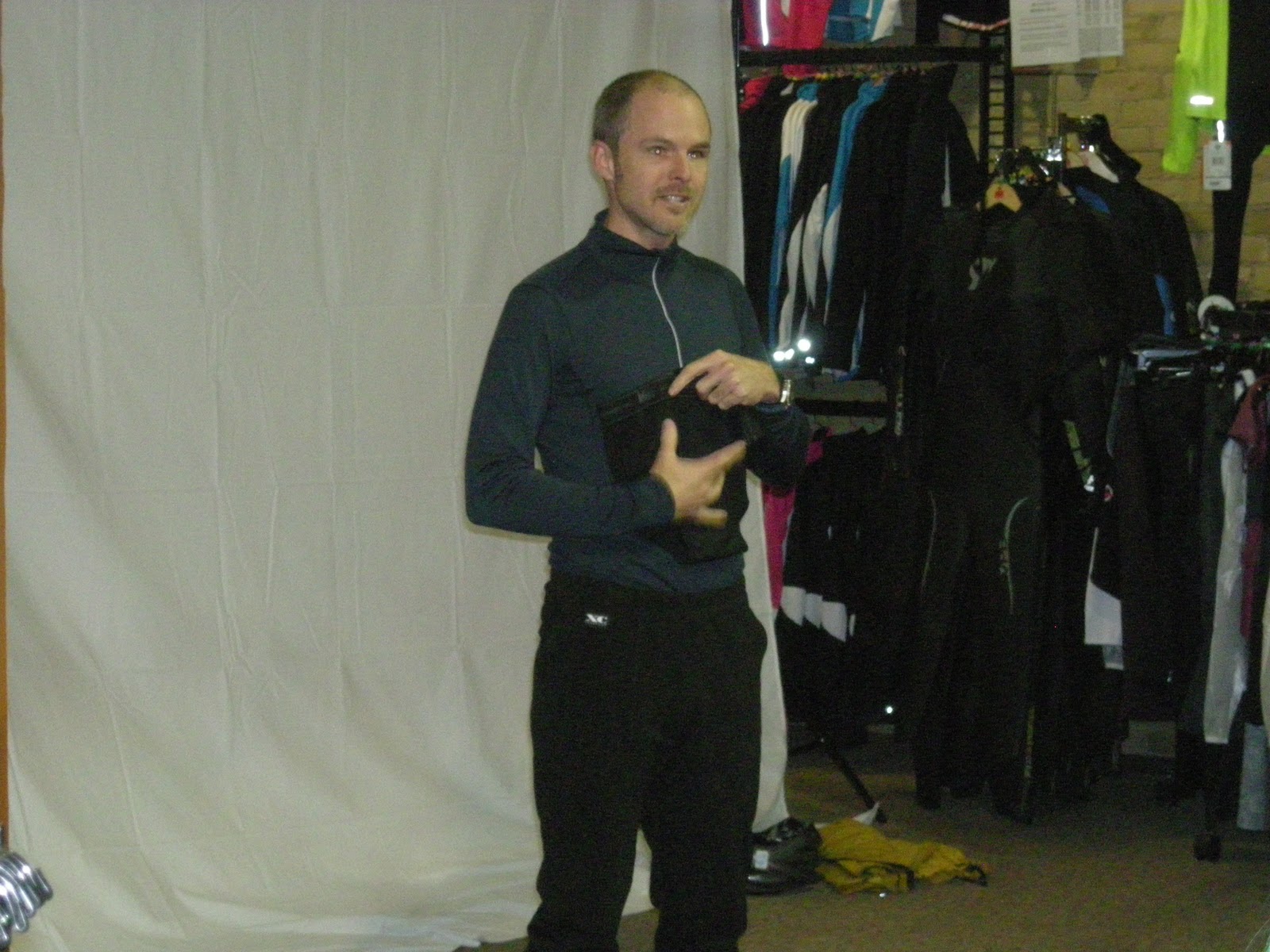
Markham explaining the importance of wind proof briefs

Saturday, October 15, 2011

Two Wheelin' in October


Old barn off Timber Lane
 Although October marks the end of long rides for me in Wisconsin (at least in shorts), sometimes I get lucky and mother nature dishes out a few nice days.  Here are some pictures of rides around home and in Milwaukee.
Sara's pumpkin patch on Old Sauk Rd.
Goats at Dreamfarm

Goats hanging out under the oak trees

Soaking up the last few sun rays

Me and Lisa on Lake Dr. in Milwaukee


Cool sculpture in Milwaukee

                                                                            Refueling at my favorite coffee spot in Milwaukee
Bike/Ped bridge

MKE riverfront
Some of my favorite beer
Darren and David finishing up their Trans WI ride in 2 days