Showing posts with label Technical Writings. Show all posts

Thursday, February 7, 2013

A few of my favorite things

Our group outside of Lakefront Brewery.  Photo by Stephen Wasmund

There are few things in life I love more than bikes, exploring cool cities, and hanging out with amazing friends--this includes my husband.  Throw in some great food, beer and whiskey and I'm like a kid in a candy store which is also a toy and pet store.

Lunch at Cassablanca
This past weekend started off perfectly with a whiskey tasting at my house.  Cycling friends gathered to help warm the cold winter night.  My thoughts may have been a bit fuzzy, however, when I planned a brewery tour for the following day.  In my defense, we were supposed to do the brewery tour the previous week but a ice/snow storm foiled our plans.

The "morning after" found the six of us jacked up on caffeine, making our way to the lovely city of Milwaukee for a field trip.  You've all heard me gush about my love for MKE--I'm not shy about it.  And although a couple people in the group had spent some time there, we were all on a mission for fun.  This mission included not only beer and food, but also the much needed bicycle (would I post this if it didn't include the beloved bicycle).

Nick working his magic.  Photo by Nathan Vergin
Our first stop provided us with sustenance of a different kind.  Call it eye candy.  The intersection of 36th and Pierce is now the new home for Fyxation--one of the coolest urban bike companies I've ever been exposed to.  Nick Ginster, and his brother, Ben started this company just four years ago.  They made their mark in the cycling community by designing a tire--that some of my fixie riding friends wouldn't trade for anything--called the Session 700.  Jump to the present and they are putting out pedals which have grips-- perfect for riding with street shoes or winter riding, track straps, stems, several types of handlebars--Nick is using one on his Ducati, bar tape, saddles, and oh yeah...they are now putting out frames and complete bikes.  Three gorgeous bikes with names like the Eastside, Riverwest and Quiver.  A cross bike is in the works.  These bikes are an urban riders dream.  Simple and elegant with thoughtful geometry and extras such as low profile fender mounts.  They have just enough bling to make you stand out in a crowd (check out the dropouts and color choices).  It's hard to believe they've only been selling frames for two months.  The word must have gotten out since several of them are already sold out.  But don't fret, Nick has got some sweet connections in Taiwan--he worked in the bike industry there for five years--and more will be rolling in soon.

Take a look at these frog--"qing wa" in Mandarin--dropouts


Fyxation's pedal and strap.
Photo by Nathan Vergin

I first met Nick at the Midwest Handbuilt Bike Show a couple years ago.  His products caught my eye as did his company t-shirt (he used a picture he took of a cyclist in Taiwan and the front simply states "bikes are better").  Nick was such an approachable guy we hit it off right away.  I was so impressed to hear he volunteers at several bike events, including wrenching at RW24 each year.  He has also sponsored my all-female alleycat, Madtown Maidens, for two years.  He lives what he preaches and he's even married to one of the staff members of the Wisconsin Bike Fed!

As with every interview I do, I sent Nick some questions.  Here's your chance to get to know one hell of a industry leader.  Oh, and if you're in Milwaukee, give him a ring, he might just give you a tour too.

Q: What's in your personal stable right now?

A:  So many bikes, so little time. I spend the most time on a prototype Quiver lately. It's gone back and forth between a CX build and city build with fenders a couple times. But as far as the rest of stable there's an Eastside single speed, Milwaukee Bruiser, mid '40s Schwinn cruiser, Kona Chute, Giant AC-1, and Ducati Monster (since it's got two wheels, it counts for the stable, right?).

Q:  What is one of your fondest bike memories?

A:  I have had a lot of great memories riding, but I always feel the best rides are ones you don't expect. While riding out at a ski resort in Colorado with my long time riding cohort Chris and another buddy we had one of those rides. The whole thing started with innocently borrowing his ex-girlfriend's car to spend a few days riding the trails at Breck. On the second day we decided to drive up to Estes park, but while climbing a steep pass the car died, big time. With a ride back to town on a flatbed truck we had a few options. The one that came to Chris' mind first was leaving the car in the mountains and riding a trail "he had heard some guys talk about" across the continental divide and back to Boulder. This was at least a six hour endeavor that would take us above tree line and over the divide, and given the time of day, a bit of a race against dusk. That was enough for the third member of our group to opt out. We promptly got some food and fueled up, headed to the local bike shop for a map and energy bars and left out of town up a steep dirt road. Needless to say it was one of the hardest and most beautiful rides I've ever done. We rode amazing single track above tree line, past mountain lakes and over at least a few unmarked trails. Somehow, we managed to roll back into Boulder at dusk, grab a cold Pacifico and plate of tacos, and settle in to let our sore legs rest.

Q:  What got you into the bike industry?

A:  I've been infatuated with bicycles and motorcycles as far back as I can remember. I rode BMX as a kid, switched to Enduro motorcycles and then to mountain bikes; all the while it had been a dream of mine to put my love for two wheeled travel together with my work. While studying mechanical engineering at UWM I landed an intern position at Hayes Brake in their test lab. That grew from the lab, to product design and eventually I ended up in Taiwan as their Chief Engineer for Asia.

Q:  You run Fyxation with your brother, and your wife works at the WI bike fed, do you ever deal with bike industry overload and what do you like doing when you just don't want to think about bikes?

Nick's Ducati...his other passion
A:  Bicycle overload, what's that? Actually, I love my work and I ride often, but I do have other past times which keeps things balanced. I'm an avid fisherman and we're fortunate to have loads of great fishing within Milwaukee. If you ride the Hank Aaron trail or along the Milwaukee River parkway this summer you're bound to see me fly fishing with my bike locked up nearby. I also have never lost my passion for motorcycles, and currently my motorcycle in the Fyxation shop getting all dialed in for Spring.

Q:  MKE has quite a bike scene and yet it isn't celebrated the way Minneapolis or Portland are. What changes would you like to see MKE make, if any? Are there any cities on your "must ride" list?

Admiring a model of the Hank Aaron trail
A:  The scene in MKE is strong, and I agree it's not as well celebrated as some of the other "biking" cities. Maybe it's our Midwestern tendency not to brag, but Miltown has a lot to offer cyclists. Our bike lanes are expanding, we have a terrific network of inter-urban bike paths, Rays MTB park is here and the rides along Lake Michigan are gorgeous and accessible. A constant challenge for cyclists is dealing with other vehicles that share the road with us. Our auto culture is tuned into looking out for other cars, and often cyclists are seen as secondary road users. The more people that are our there on their bikes, the more cyclists are seen as equal road users. I believe that cities that focus on getting more people riding by building safe corridors for cycling increases the safety of cyclists, not only by giving us designated riding lanes, but also by drawing more cyclists to the streets and thereby increasing drivers awareness of riders. As Wisconsinites we're fortunate to have an organization like the Bike Fed advocating for us. If you're not a member, I would encourage you to join. They're doing great things us every day.

Q:  You've spent quite a bit of time in Asia, how does the urban bike culture differ there?

A:  The urban cycling culture in Asia has undergone a big transformation in many cities over the past decade. For ages bicycles were seen as utilitarian vehicles only. With financial success families would ditch the bike for a scooter or motorcycle, and eventually a car. In many places this created a stigma around cycling and ones prosperity. That has changed a lot recently. I saw this first hand living in Taiwan. When I first started travelling there you would never see people out riding for pleasure or exercise; however, during the time I spent there the number of people riding bicycles exploded. Bike shops popped up everywhere, with companies like Giant and Merida opening concept stores packed with the latest carbon bikes. Urban cycling culture popped up in cities like Taipei, Jakarta and Bangkok--fueled by young riders first looking towards Western trends, but eventually carving out their own culture--and is still going strong. I've had the good fortune of participating in urban riding and fixed gear events in Asia, and I can tell you there an infectious enthusiasm there now.

Q:  What, in the bike industry, has you in awe at the moment?

A:  After more than 15 years in the industry it's hard for me to be awestruck, but I do enjoy how the cycling industry continues to evolve. Fat bikes and 650b are two categories that didn't exist a few years ago, but are seeing explosive growth. Hydraulic brakes for road bikes stand at the edge of becoming a reality. I am also encouraged by the number of people turning towards cycling for transportation. There are a lot of great companies really looking at urban cycling and saying "what makes sense for people that ride for transportation".  In large part this has driven our new road/commuter platform, the Quiver.

Q:  You've done so well in the urban bike accessory business in the past few years, why now did you decide to break into the frame/complete bike business?
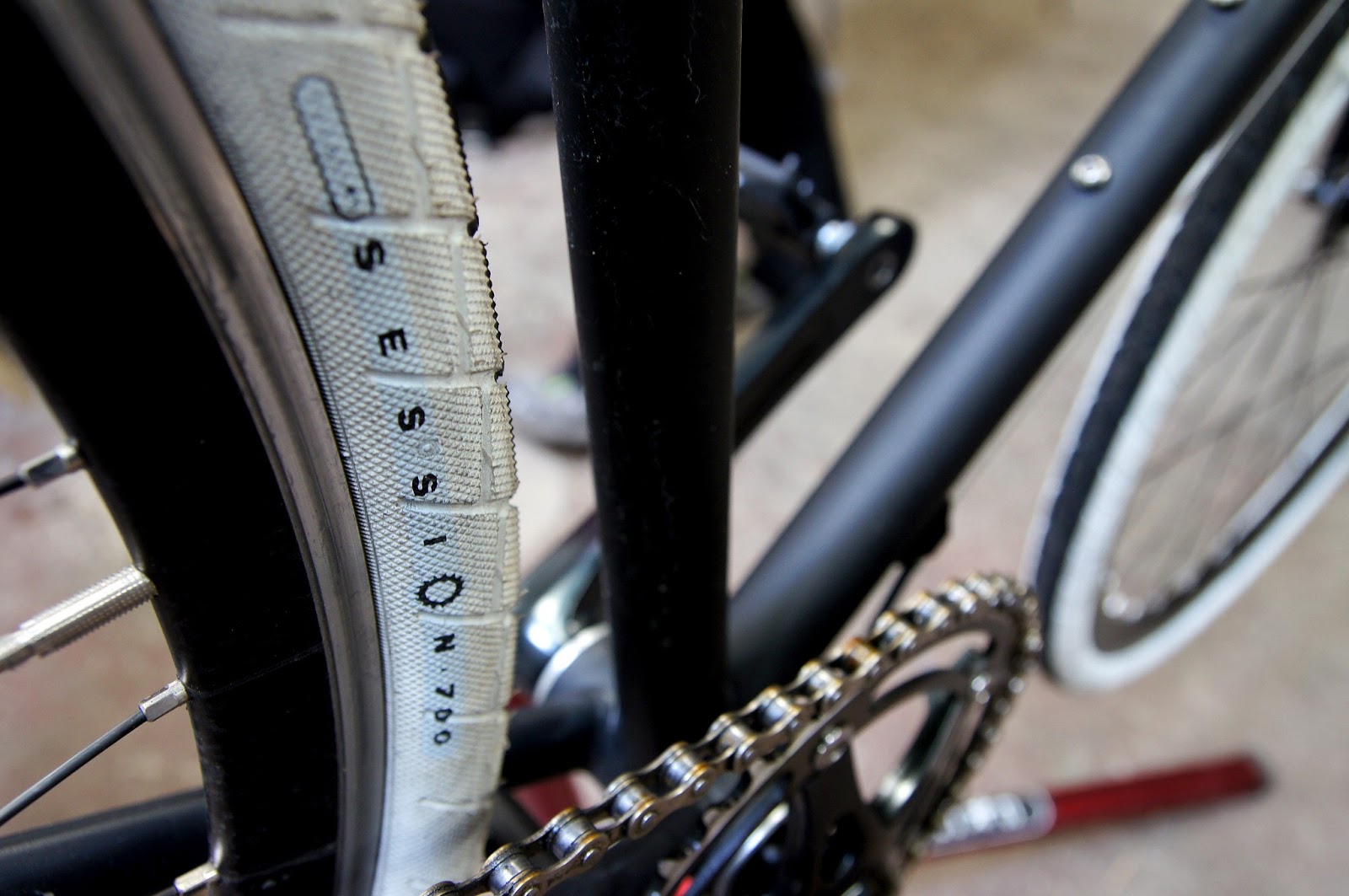
The Quiver with the tires that started it all--Session 700
Photo by Nathan Vergin

A:  We have been busy rounding out our component line over the past four years and have gone from two guys and a tire, to an established brand with over 30 components and as you mentioned we're moving into complete bikes. Although bicycle manufacturing is new to Fyxation it's not new for us. I've been involved in design and manufacture of bicycles for other companies for years, so this is a natural evolution for Fyxation. Bringing affordable, quality components to riders has always been our focus and our Eastside single speed and Quiver road/commuter bike fit that mission perfectly. The Eastside combines clean styling and quality components in an affordable package, and the Quiver is loaded with innovative features that make it a perfect commuter platform. My wheels never stop turning and there are a lot of exciting projects in the works at Fyxation, so be sure and stay tuned!


Ending our tour of Fyxation with a mini tour of the Wisconsin Bike Fed office
Photo by Nathan Vergin
Had to end the day with the swings under the Holton bridge
Photo by Stephen Wasmund


Wednesday, January 23, 2013

Ethiopia

I'm a Northern girl.  Born and primarily raised in the upper Midwest.  My ties to Africa are few.  Other than having a few friends who were born in South Africa, being fascinated  with Morocco and following team Rwanda, I haven't been drawn to any one thing in this massive continent--until now.

A couple months ago, Jonathan Patz approached me with a project he just started.  He told me about Ethiopia--a country I, like so many others, associated with poverty and famine.  Since Jon's work deals with climate change and public health, a large concern of his, and several leaders in Ethiopia, is air pollution and the health of residents.  In only the past six to seven years, Ethiopia has seen quite a bit of change.  Roads have been paved--funded mostly by China, the economy has boomed, higher education has increased, the leaders are promoting a green technology/economy and gas rickshaws have taken over the roads.

This country, flanked by Kenya, Sudan, Eritrea, Djibouti and Somalia is on the verge.  On the verge of either falling into a trap that most wealthy countries have fallen into, or changing the rules and working towards truly bettering itself for generations to come.  We have all witnessed the rapid changes in China as the middle class has grown and the automobile has become king.  The United States, I'm sad to say, is no better.  Before even beginning to work on this project, I had to ask myself "Who am I to ask another place to change their way of living?" 

So how does the health of Ethiopia relate to cycling you ask?  Well, this specific project, although in the absolute beginning stage, has to do with the gas powered rickshaw.  For those of you who have never seen a rickshaw, it is essentially a bicycle cab.  Used to transport people and goods, it is usually the most economically friendly and the fastest way to move through cities in third world nations.  Just seven years ago, the rickshaws in Ethiopia were human powered.  Now, they are gas powered and have increased in such great numbers it is difficult for people to maneuver through the streets on traditional bicycles.  Jon's project is three fold.  One, we'd like to see the rickshaws be turned into electric assist with solar panels.  Two, we'd like to see a bicycle/pedestrian infrastructure put into the city of Hawassa to be used as model in hopes of it spreading throughout the country.  Three, we'd like Ethiopians to gain jobs by having them repair the rickshaws and possibly manufacture them.

As I stated, we would start with our focus on the city of Hawassa.  This university city, about the size of Madison, sits roughly 270 km South of Addis Abada--the seat of the African Union.  It's a perfect place to start in more ways than one.  It already has a road system in place that would lend itself to bike lanes, women are often raised biking there and it is safe for them and finally, the former mayor and now current vice president of the University of Hawassa along with the president of health services at the University of Addis Abada want these changes to occur.  All change must start as a drop of water in the bucket.  Hawassa could be used as a test tube for the rest of Ethiopia and possibly Africa.


Yesterday, with a balmy temperature of 3F, I biked downtown to brainstorm with a very impressive group.  Our diverse collective included Jonathan Patz, director of the Global Health Institute, Spencer Black, former state representative and current professor of urban and regional planning, Brandon Booth who does advocacy for Trek, Jake Moskol, assistant director at the Global Health Institute, Jason Vargo, a fellow at the GHI, Brian Anderson, attorney at Whyte Hirschboeck Dudek and current bike fed board member, Maggie Grabow, current phd student at GHI and  Selamawit Zewdie, who works with the Hawassa Children's Project and with Jon Patz.  Dave Cieslevicz and Joe Sessenbrenner (both former Madison mayors) will also be included in the project.  I was overwhelmed by the energy and excitement this group had regarding this project.  Thoughtful questions were raised and I think we made some amazing first steps.  To be in a room with so many positive people, who want to work on public health by promoting bicycle usage, makes me happy to donate my time.  Although Ethiopia is far away, ultimately their health as a country affects us all.  Yes, I usually follow the "think globally, act locally" rule of thumb, however, the thought of working with a city/country that is on the verge of an enormous change (good or bad) excites me.  I doubt I can make much of a difference but I will most certainly learn a lot along the way.

Check out this video below that Brian Anderson sent me.  It only makes me want to bike in Ethiopia even more!


Me (on right) and Jonathan Patz (on left) biking to the meeting

Our group in Brian Anderson's law office

I want to thank Jon for including me in this project, all the amazing people that showed up to the meeting and Whyte Hirshchboek Dudek law firm for providing us with a beautiful meeting space.

Friday, November 30, 2012

Crushing Gravel?

There will be gravel.
There will be mud.
It will be cold.
Some will cry.
We will not wipe your tears for you.


Trans Iowa 2010.  Photo courtesy of Kristin Riching

These are the lines that greeted me on the event page for Dairy Roubaix.  Come mid April, I'll be attempting my first gravel road race.  Don't ask me why...I'm still trying to figure it out.  I can only guess that my decision was made after several beers.  This is when I make most of my stupid and yet fun decisions.  All I know is that an ugly little seed got planted in my brain last April when my husband and I shared a short section of the course while on a mini bike tour.  I can also put some blame on my friends since several of them race Dairy Roubaix, Almanzo, and Trans Iowa (three more friends are training for this suffer fest right now). 

The first few times I allowed the idea of racing/riding these events grace my mind, it played out like a horror flick.  Why the hell would I want to go down 20% grade gravel hills?  Going up doesn't seem to bother me so much, but the down part kinda makes me want to puke.  My husband knows me well enough to foresee mini meltdowns on my end when we go down steep, freshly chip sealed roads.  He, of course, isn't riding the Dairy Roubaix, so I'll have to contain my whimpers at all costs.  

Until the actual race date comes into focus, I can count on Kristin Riching, BJ Bass and Michael Lemberger  to be my Obi Wan Kenobis.  I asked them each a few questions to enlighten those of you who have not heard of gravel road racing.  Who knows...maybe more seeds will be planted.

Q:  What got you started in gravel road racing and what was your first race?

Michael:   My first race was the 2011 Almanzo 100. Raining, windy and 44˚F. Made it about 32 miles in before we got cold and called it. Rode another 14 back to town on pavement. Finished the 67 mile version of the 2012 Dairy Roubaix. About 70% gravel. Very hilly.

Kristin:   Trans Iowa was the first gravel race for both of us.  BJ signed up for Trans-Iowa V3 because (being stupid boys) he and his friends Matt and Travs refused to back out after Matt sent a link to the website with the subject "check this out".  I attempted the following year as I was converting into a more avid cyclist and I had heard talk of little else since starting to date BJ!

Michael doing a bit of trail riding and camping.  Photo courtesy of Micheal Lemberger
Here's Michael after an actual race.  Photo courtesy of Michael Lemberger


Q:  How do you train differently for these types of events?

Michael: Uhhhh...  *I will note that Michael is currently training for Triple D and rides year round, so really he never stops training.

Kristin:  100 mile races are trained for by doing 50-100 mile rides on weekends, and 2-3 20 mile rides during the week.  Try to keep the intensity high for as long as possible and then limp home.  We usually depart into a headwind and return home with a tailwind which give you something to look forward to during the ride.

TheTrans Iowa is a little different being a much longer and completely unsupported event.  The key to training for T.I. is to schedule your training rides and then do them regardless of weather or conditions.  We typically do a century each weekend starting 10 weeks before the race, and have 1 weekend a month before the race where 120 miles are ridden each day.  A trip to Galena or Sheboygan makes it a lot harder to punk out on day 2 of that weekend.  Equipment is also very important, and endless deliberation on just the right equipment keeps the training interesting and gives you something to discuss with other riders.  Keep experimenting to keep the rides interesting. Training rides are as much about fitness as testing equipment and finding out what works for you.  A strict rule to follow: never race on anything you haven't tested for at least 100 miles.  

Q:  Are there any gravel events that you haven't done and are on your "must do" list?

Michael:  Trans Iowa  *Michael will be doing his first TI this spring!

Kristin:  No.  First and foremost, gravel racing is social.  The distance of the events keeps most riders at a conversational pace for at least half of the race.  We'll do a few per year based on which ones have been fun and free, and where our friends are planning to ride.  Especially in the unsupported events we all need to look out for each other.  Being friendly and social is important under those circumstances.
Q:  Explain what gear you like to use for these events.

Michael:  Not-so-fancy Surly Cross Check with good wheels and tires; 1x8 or 2x 8 drivetrain. Minimal cool-weather kit. Food and water.
Kristin:  Bike: cyclocross or hybrid frame with drop bars, disc brakes preferred for when it rains or gets muddy/snowy. Have clip on fenders as an option, but full coverage fenders can pack solid with mud.  Do not use full coverage fenders on gravel when it's raining.  They will fill with peanut butter.  We run the largest semi slick tires we can fit in our frames.  In the case of our bikes the continental cyclocross speed 700x42c tires roll well, provide plenty of cushion, and don't puncture.  Picking tires based on weight usually leads to time fixing flats.  Don't worry about using an all-around cyclocross tread, gravel bounces too much when it's rough to make use of it, and gravel provides enough vibration without the help of knobby tires.  Frame bags: make sure you can shoulder your bike when it's necessary.  Even a 30 foot stretch of mud can be brutal if there isn't a good way to carry your bike.  Kristin's frame is small, so she typically just uses a seat bag and relies on a camelbak to carry extra gear and food.  BJ uses a small frame bag (one that still allows access to water bottles) a camelbak, and two seat bags (a standard type and one that hangs from his Brooks saddle.)  BJ uses a brooks saddle with springs.  It weighs a ton, but remains comfortable after 340 miles of gravel and washboards.  Kristin uses Bontrager Inform Race saddles, which have a little more padding than the higher end RL versions.  Clothing is really personal.  The main things that we consider are: make sure there's a place to store layers you shed, and when it's cold out, bring an extra shirt to change into if you plan to stop and eat during a ride/race.  (this may be more important during training rides)  For cold weather, make sure layers are breathable.  Using a windproof layer that doesn't allow you to dry off will just lead to getting soaked and chilled inside your jacket.  We use gel inserts under our handlebar tape.  Double wrapping makes the bars too large in diameter for both BJ and Kristin.  Kristin uses toe warmers for temperatures up to 45 degrees.  Always overdress on your hands and feet when it's cold.  We typically assume that we'll drink 1 ounce of liquid per mile, so a 100 mile race unsupported will likely include 2 water bottles and a 50 oz camelbak.  This rule doesn't work when it's hot out, but at temperatures between 30 and 65 degrees it holds pretty true.  Don't skimp on water storage by drinking 50 oz before leaving, you'll just end up peeing on the side of the road.  Both of our bikes can be turned into singlespeeds in case the derailleur hanger gets torn off.  This hasn't been necessary yet, but it happens to a lot of people and Kristin had a close call last year.  Any advice we might give about bike fit is really personal.  Make sure you are comfortable in multiple hand positions.  Many bikes are set up with the bars too low to make good use of the drops.  Make sure that the tops, drops, and hoods are all viable options even when you're tired and sore.
Kristin's bike for Trans Iowa
Q:  When the going really gets tough, what tricks do you use to keep going?
Michael:  Uhhhh...dogged determination and speed metal.
Kristin:  Different people respond differently to getting super exhausted and worn out.  BJ never considers quitting an option.  The truth is that most of these races require that you keep going to make it home.  Plan B is often an hour or two away and freezing in the ditch until your ride shows up is typically less appealing than gritting your teeth and pedaling those two hours to get home.  However, if bike riding is causing suffering, you're doing it wrong.  There is a lot that we give up to do these races.  Weekends, family time, and relaxation all get sacrificed on the altar of gravel races.  Time spent on the bike should be as enjoyable and fulfilling as the alternatives.  Gravel racing doesn't have a strong culture of social status given to the winners. There is typically no prize money.  Time spent riding and fond memories are all the reward you can expect to be given.

Kristin (on the left) on Trans Iowa.  Photo courtesy of Kristin Riching


Monday, January 30, 2012

It Takes Two

Dave and Mary Pramann on the podium for the tandem race

You may call it a "tandem", whereas I call it a "divorce mobile".  Oh, I'm not being cynical--well, maybe I am--but I am frequently told stories about couples getting into enormous arguments while riding on a tandem bike.  Of course these are the same couples that are constantly pushing me and my husband to borrow their tandem...as long as we want.

Now don't get me wrong, I'm not saying that there aren't couples who actually enjoy riding together in this fashion.  In fact, there is actually a group of them called COWS (couples on wheels) right here in Wisconsin.  They get together for occasional rides including an enormous annual meet-up.  I also know that rides like RAGBRAI in Iowa and SAGBRAW in Wisconsin pull these riders out of the woodwork.


When working together, these couples can cruise by a solo rider like a locomotive train.  I've ridden with several of these couples and I can feel them barrelling down upon me--especially when going down hill or on flats.  Uphill is another story.  This is about the only time I can seek revenge on them.

So what's my big hang-up with tandems?  Well, I see them like canoes.  If one person isn't pulling their weight or has a different "style" or "technique", it completely throws the other person off.  First, one of the the two must be comfortable with giving up control (I have a sick "not me" attitude with this).  Second, the person up front has to trust that the person in back isn't slacking.  This isn't like dog sledding where there's a driver with a whip keeping everyone in tow.  Third, one of the riders will always have an obstructed view (again with the "not me" attitude).  I admit it, I'm a back seat driver, which doesn't work when cycling.  I always want to pick my own line and pace.

So getting back to the canoe analogy.  There's a story behind this...
Before my husband and I were married, I thought it would be "fun" to go canoeing down the St.Croix river together.  No portaging, moving with the current...what could go wrong?  Of course my type A driven self chose bow.  In past canoe trips I always liked the monotonous push without having to perform all the "J" and "C" strokes.  Anyway, it didn't take long to realize that solo kayaks would have been a better choice.  We survived--and still got married--but always knew we couldn't be tethered to each other.

Our 10th anniversary bike tour through Wisconsin
This doesn't mean that we don't like riding together.  On the contrary... we LOVE riding together!  We go on the country rides as "dates" and will often ride downtown for concerts or dinner in the summer.  Some of the most joyous experiences I have had with my husband revolve around biking.  We even spent our 10th wedding anniversary riding Wisconsin top to bottom and finished the last few blocks hand-in-hand.  We just know our limitations.

2010 COWS ride in Madison
Marie and Jeff Matous

It takes a very special couple to be able to ride tandem regularly.  I thought it would be fun to include some pictures of folks I know that do so and with a smile on their face.  I'm wishing them and other couples that bike together a very happy Valentine's day!  A special shout out to David and Mary Pramann that not only ride tandem but also raced tandem for many years...now that takes guts.

For those that are interested in COWS, check out their website www.couplesonwheels.com

Tuesday, January 17, 2012

Zinn and the Art of Bicycling


Lennard Zinn at cyclo-cross nationals 2012
photo by Nathan Vergin


Imagine a world where you step into a bike shop with someone and the person you're with is treated like a rock star.  Crowds form around him, pictures are taken, hands go out to be shaken, pats on the back and a beer magically appears.  You might even see some female cyclists swoon--actually, the guys might be swooning as well.

This was my perspective when Lennard Zinn was in town for cyclo-cross nationals and we walked into Machinery Row bike shop for their Belgium party.  It was kind of amusing...but then again, I got it.  Growing up I cared a lot more about pro racers than rock stars--they were my rock stars.

So how did I find myself in this position?  Thanks to a good friend, Jon Patz, who was an old roommate of Lennard's, I got to have dinner with him and interview him after his race.  I was even treated to a story of them knitting hats in their college dorm room.

It's hard not to spot Lennard in a crowd.  He's 6'6-6'7, has a lean athletic build and warm smile.  For those of you not familiar with his work, the list is long.  First, he's written several books on bike maintenance including the mechanic's bible "Zinn and the Art of Bicycle Maintenance".  He's the technical writer for VeloNews.  He started Zinn Cycles where he designs and builds custom mountain, road, cross and tri bikes.  He designs components and clothes to fit tall and short riders and he also races (both bike and cross country ski).

How did he get involved with all of this when he started out as a physics major?  Simply put, he loves bikes and bicycling!  During dinner we were talking about the start of Zinn Cycles and he said, "Contrary to what most people think, I actually got into this because I was tired of seeing shorter women bounce around in their saddles due to cranks that were too long for them."  I have to admit that even I thought his driving force was to help taller riders.  As a hard to fit rider myself, it's wonderful to see a frame/component builder care so much about sizing.

Scott Anderson, a 6'6 yoga instructor, here in Madison, is a believer in what Zinn is doing.  I asked him to contribute to this piece and here's what he sent:

 It was nearly twenty years ago that I first rode a Zinn bike. In the days before Internet ubiquity, information was more likely to be passed word-of-mouth, and I'd heard that Lennard Zinn was the go-to guy for big bikes. Well, I certainly needed one of those big bikes at 6'6"! I had been riding an off-the-shelf Ritchey, which was a gorgeous piece of equipment, though it didn't even come close to fitting. Via the combined efforts of an extra-long seat post and a supple spine, I thought this bike was as good as it gets. The Ritchey ultimately showed its age, however, and it came time to replace my trusty steed.

On a trip to Boulder, Colorado in 1993, I swung by Lennard's shop. Rather than talking about bikes and fitting, Lennard suggested we go out for a ride. He let me ride his bike, and he grabbed another as we rode about the Boulder reservoir. Within about ten minutes I'd decided to purchase this bike; it tracked straight (lacking the twitchiness I associated with a high-end bike) and did not require committee-approval to turn. It was the smoothest, easiest-riding, fastest and most comfortable bike I'd every ridden!
I loved that bike, and poured on off-road miles all over the Southwestern US, and gobs of commuting miles in both Minneapolis, MN and Madison, WI. (Even after it was completely and utterly tired and worn, it still commanded a respectable bid on eBay last year.) People properly appreciate Lennard's gift for building the right bikes for BIG people.
Since Scott is a yoga instructor, he also mentions that although he can help people become more adaptable and resilient, those things can only go so far.  He sees so many riders trying to make too-small bikes work for them but one size does not fit all.

Lennard is so dedicated to helping those that are hard to fit that he started a program with basketball players and the Boulder Center for Sports Medicine.  Zinn and Andy Pruitt, a certified athletic trainer, work with athletes on bike fitting to help them prevent back, knee and neck injuries.

Zinn has not only been a leader in bike fitting but also in using different frame materials.  Although he loves steel, his bikes now lean towards titanium and magnesium.  Until cross nationals, I had never seen a magnesium frame.  After his race, while his bike was still covered in mud, I picked it up.  Even with a full water bottle and a few pounds of mud, it was still lighter than my much smaller carbon frame.  My jaw dropped and I think I drooled a bit.  Calculations of how I could scrape enough money together to get one of his frames started dancing in my head.  The best part is that his frames are made right here in the United States!

Lennard and Dag after the race
photo by Jon Patz

I couldn't resist sending Lennard a few questions for this post.  Here they are with his responses plus photos:

 1)       What is one of your fondest cycling memories?

Winning the Durango-to-Silverton Iron Classic road race in 1980. Felt like I was floating that day. I set the course record that held until Jonathan Boyer smashed it a couple of years later.
One very hilly stage of the Tour of Ireland in 1981 where I felt great, initiated the break, and won the Most Aggressive Rider award.
  2)      Regarding bicycle building, what frame are you most attached to and why?

Wow. Hard question. I guess I'd never throw out or sell the first bike I ever built (in 1980, for my girlfriend who became my wife). 
I'm currently most attached to both of my cyclocross bikes (http://www.cyclingdirt.org/coverage/247673-USA-Cyclocross-National-Championships-2012/video/559767-Leonard-Zinn-Very-Technical-Cyclocross-National-Championships) , but I'm sure they'll be replaced within a few years, so that hardly seems like attachment. 
I poured my heart and soul into the Columbus KL steel lugged bike of my wife's. She still rides it, we'd never get rid of it, and it weighs like 15 pounds, built back in 1984 or so.
My wife and I haven't ridden our tandem in years, but we are very attached to it, as it is what we rode when she was pregnant with each of our daughters. It has kisses all over it under the clear coat.
  3)      When you first started building, were there any frame builders that influenced you and why?

I worked for Tom Ritchey after having only built one bike prior to that. I even lived at his house part of the time; the shop was in his garage up on Skyline Drive above Palo Alto. He had a very strong influence on me. Between Tom, me and one other guy, we built around 100 fillet-brazed Ritchey mountain bike frames, forks, and Ritchey Bullmoose fillet-brazed handlebars a month (at the very beginning of the mountain bike boom in 1981). Understanding how a small operation could be super productive was very useful to learn, and for the bikes I made in the 1980s until the mid 1990s, it was great that I had learned from Tom how to fillet braze (and without air bubbles) and especially how to finish the fillet so that it was super smooth and made a beautiful transition from tube to tube.
I learned how to weld titanium and tricks of building frames out of it from Gary Helfrich, the founder of Merlin. 
Otherwise, I was inspired by the beauty of old-world lugged frame craftsmen when I was starting out.

 4)      What bikes are you riding now?

I have two matching 17-pound magnesium cyclocross bikes with single chainrings and 205mm cranks visible here
http://www.cyclingdirt.org/coverage/247673-USA-Cyclocross-National-Championships-2012/video/559767-Leonard-Zinn-Very-Technical-Cyclocross-National-Championships and in the below photo of me and DAg Selander by Jon Patz (he and I have lots more from nationals).
http://zinncycles.com/Zinn/index.php/cyclocross/1532-2
In five minutes, thanks to replaceable dropouts on both sides, I can convert them to singlespeed 'cross bikes (see photos of red bike below).

I have a sub-17-pound Zinn Fassa magnesium road bike with Campy Super Record 11-speed. I love that bike for long mountain rides.  http://zinncycles.com/Zinn/index.php/test-page/project-big-custom-series/fassa-mg

I have a titanium bike with four couplers on the frame and a coupler on the titanium stem that I travel constantly all over the world with. I've raced a lot of Gran Fondos in Italy and Canada on it. I can pack it in about 10 minutes into a 28 X 28 X 10 case that flies free. This video shows me packing it and shows Madison's native Olympic Gold Medalist on her Zinn coupled titanium bike.http://zinncycles.com/video/Travel-Bike-Promo.html?keepThis=true&TB_iframe=true&height=355&width=455. This bikes gives me incredible freedom and allows me to have great rides wherever I am.
I also have a steel bike with four couplers on the frame that has such a beautiful green powder coat on it that I rarely travel with it, but I do ride it a lot around here. (My titanium travel bike is unpainted and hence I don't worry about scratching it when traveling.)
I ride the 6-inch travel Zinn Gigabike 29er equipped with SRAM X.0 and Fox TALAS Terralogic fork that is on the cover of Zinn and the Art of Mountain Bike Maintenance. https://bigandtallbike.3dcartstores.com/Zinn-and-the-Art-of-Mountain-Bike-Maintenance-5th-edition_p_136.html 

I ride a titanium 3-inch travel Zinn Tyrant 29er equipped with SRAM XX components and fork. http://zinncycles.com/Zinn/index.php/about/classic-custom-series/full-suspension/tyrant

I have a bright yellow magnesium track bike that I ride on the indoor velodrome here in Boulder.
All of the above bikes have my custom Zinn cranks on them.

5) You’ve been such an influence on folks wanting to learn bike maintenance.  What would your top three tips for those just starting out--besides buying your books?

1. Just get started working on your bike. Don't be afraid to take something apart. While it's possible you may make a mistake, there's no better way to learn.
2. Build some wheels. It's good for the soul to ride on a pair of wheels you built.
3. Just as you take a shower after riding, spend a bit of time on your bike after every time you ride. At a minimum, wipe the drivetrain with a rag and lubricate the chain after every ride or two.

Me with Lennard Zinn
photo by Jon Patz


Wednesday, November 16, 2011

7-Eleven isn't just about convienence

When you hear the word 7-Eleven what comes to your mind?  For many it's slurpies and big gulps.  For me it's one of the biggest shifts in U.S. cycling.  This past weekend I got the pleasure to work at the Saris Gala (largest fundraiser for the Wisconsin Bicycle Federation) and meet the 1986 7-Eleven team (including my hero Raul Alcala). 

Eric Heiden racing around the Madison capitol in 1982
What makes the 7-Eleven team so special?  It was the first American team to race in the Tour de France in 1986...'nuf said.  The team was pulled together by Jim Ochowicz in 1981 who had spent years managing the U.S. national speed-skating team.*  Jim accomplished an amazing feat by landing sponsorship with 7-Eleven and Schwinn.  The team actually consisted of not only bike racers but also well known speed skaters like Eric Heiden (who is from Madison, Wisconsin).

In 1982 Schwinn dropped out but a women's team was added.  Although I was only 7 years old I remember being so excited about this.  Seeing women race on a pro level meant so much to me since I was just entering the road racing world.  One of the women that signed on, Rebecca Twigg, helped shape my world and I wrote about her in a previous post.  Davis Phinney (now married to Connie Carpenter and the father of Taylor Phinney), Ron Kiefel and Alex Stieda also were recruited.  Shortly after this team was formed, they were featured in the movie American Flyers.

Andy Hampsten
In 1985 the team went from amateur standings to professional and with the addition of Chris Carmichael, Tom Schuler and Alexi Grewal they won an Olympic bronze.  That same year, the team was invited to the Giro d'Italia (one of the classic European races) and Andy Hampsten was signed on with a 30-day contract.  Hampsten and Kiefel both won stages that year in the Giro and became the first Americans to ever win a stage in a Grand Tour.

1986 proved to be the biggest year for the team.  They were invited to the Tour de France and performed extremely well as a team with the additions of Raul Alcala, Jeff Pierce and Bob Roll.  In the following decade, the 7-Eleven team went through several sponsorship changes yet continued to be a major force to reckon with in the racing world.  They finally disbanded in 1996 yet many of the racers continued to be successful on different teams.

Although the names of Lance Armstrong and Greg Lemond are thrown around frequently as the best U.S. racers, I can't help but think of all the other workhorses out there that completely changed the face of American racing.  These guys deserve so much more recognition than they will ever get!

*Speed skating and road racing went hand in hand for many years.  People didn't train inside very much during the winter back in the 80's.  They opted to speed skate for their cross training instead.

Me with Raul Alcala (one of my heroes).  Raul won the Mexican Time Trial championships last year...when he was 46 years old!


Monday, August 29, 2011

Bicycle Envy is NOT a Deadly Sin

Lance Armstrong wrote the book "It's Not About the Bike".  Am I really supposed to believe one of the biggest dopers who to this day claims he's never doped?  I hate to break it to you but often times it IS about the bike.

Yes, there are a lot of people out there that just see bikes as a form of transportation or exercise...and I will give those folks a standing applause for making the world a better place.  For some of us though, the bike is so much more.  An art form, a way to connect with others (or not connect at all), a way to express his/her emotions on any given day and a way to be part of a specific culture.

I was talking with a friend the other day about how I see myself in the bike culture.  Amazingly enough I'm a one foot in/one foot out kinda girl.  I admit I'm a bit obsessed with bikes (and everything that comes along with them) but I just can't fully commit to one "style".  To be honest, I want it all.  I'm the type that sees a great looking bike go by (yes, I'm checking out the bike not the rider) and I have this Pavlovian response.  My heart rate quickens, I shut out everything else around me and a slight feeling of envy (or is it greed) washes over me.  Some may see this as a sickness.  I just remind them that we all have our vices and aside from good coffee, wine or beer, this is mine.  It could be worse.  So how deep does this envy cut into me?  Well, I have a running list of desires that only gets longer each year...a Chris Kvale road frame (he built my father's old race bike), a Richard Sachs cross bike (waiting list of 6 years), a Bruce Gordon touring frame (but I'd be thrilled to have a Chris Kvale touring frame), a Peacock Groove mountain bike and a Rivendell road frame (just because they are so damn pretty). 

But it gets worse.  This past weekend Madison was the host site for the Heartland Velo Hand Built Bike Show.  Walking around I thought I had died and gone to heaven.  Many of the frame builders showing their art are now making it to my list.  I'm including pictures because words can do no justice.  Heck, pictures can do no justice!  Thanks to all of you craftspeople that showed up and made Madison a whole lot prettier last weekend.  I can only hope that you all get a ton of business and a 6 year waiting list!
I'll end with this quote from Grant Petersen:  "Think of bicycles as rideable art that can just about save the world."
Chris Kvale, one of the best frame builders ever!

Look at his classic style!


Clockwork out of Tosa

Speedhound is out of Mpls.  Check out the fenders!

And look at these details...

Capricorn out of Mpls. but soon to be in Eugene, OR


The Waterford "Erica"


Beautiful!
Lisa's All City...this is the road frame...I've got the Big Block


Bilenky out of Philly


Humble Frameworks out of Chicago


An old Schwinn Paramount (my dad used to use one of these for racing)